Saint Giong Festival- A world intangible cultural heritage of humanity.
The Saint Giong Festival has been evaluated by domestic and foreign researchers as the most unique among the 7,000 traditional folk festivals of Vietnam with special cultural and religious values. For this reason, the festival has been recognized by UNESCO as a world intangible cultural heritage of humanity.
Saint Giong Festival has existed for thousands of years
With this sacred feat, people called him “Phu Dong Thien Vuong” and honoured him as one of the “four immortals” or “four genies” (Saint Tan Vien, Saint Giong, Saint Chu Dong Tu and Saint Lieu Hanh) who were worshiped by the Vietnamese people in the Red River delta.
Nowadays, to commemorate his exploits, people in many places in the Red River delta region annually organize the Saint Giong festival with unique rites imbued with the ancient Viet’s cultural imprints. However, the biggest and most special are the Saint Giong festivals in Phu Dong Temple in Phu Dong Commune, Gia Lam District, Hanoi – his birthplace and in Soc Temple in Phu Linh Commune of Soc Son District, Hanoi - the place where he flew into the heavens.
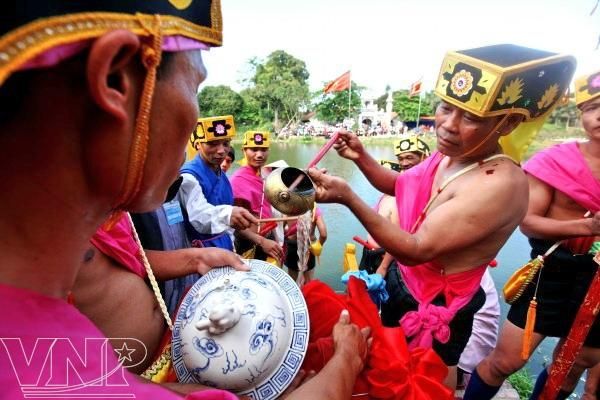
![]() The ceremony of receiving a certificate recognizing the Saint Giong Festival as a World Intangible Cultural Heritage of Humanity. ![]() Thousands of people attend the inauguration of Saint Giong statue on the peak of the Soc Mountain in Hanoi. ![]() Phu Dong villagers prepare for the Saint Giong Festival. ![]() Carrying offerings to the festival. ![]() A procession of water, which starts the Saint Giong Festival, has the meaning of taking water to clean weapons before the battles and pray for good weather and bumper crops. The St. Giong Festival is organized on the banks of the Red River. |
Unlike other folk festivals, apart from praying for good weather, bumper crops and commemorating saints and genies, the Saint Giong festival is considered an interesting “dramatic folk stage” because it attracts the participation of thousands of local people. They perform plays to reenact the battle of Saint Giong. Although the performances are symbolic, they convey a profound philosophy of life. They show the virtues, intelligence, faith and bravery of the general for the fate of the nation; the finial piety; the tolerance of the winner for his rival; and the aspiration for living in a peaceful and happy world.
Over the years, the festival has had a great influence on the cultural and religious consciousness of the Vietnamese people in general and the people in the Red River delta in particular. Therefore, many relics as well as cultural and religious imprints related to Saint Giong are now seen in some rural areas. For example, there are many ancient architectural works with great value, such as communal houses, temples and shrines in the two communes of Phu Dong and Phu Linh.
For many years the villagers in these two communes have annually organized the festival on January 6 and April 9 according to the lunar calendar to honour their national hero. The French researcher, G. Dumoutier, was so impressed by the value and jubilant atmosphere of the Saint Giong festival that he wrote in his book, “Revue de l’histoire des religions, Paris 1893”: “The Saint Giong festival, the most moving scene that we have ever seen in the north of Vietnam will live forever in the mind of each viewer. In our ancient Europe if people will feel proud of celebrating a historical event taking place two or three hundreds of years ago.”
The most prominent value of the festival is that it has been preserved and handed down intact from generation to generation. Despite the ups and downs of history and influence by foreign cultures, the Saint Giong festival still keeps its unique features and is not commercialized like other festivals.
Unique Saint Giong Festival
According to researchers, the festival in Soc Temple seems to be a praying for crops festival seen in most spring festivals in the northern plain and the midland regions. The festival in Phu Dong Temple in Gia Lam, Hanoi is seen as a traditional cultural festival reenacting authentically the happenings of the battle of Saint Giong.
Recently, on April 9, 2011 of the lunar calendar, villagers in Phu Dong Commune organized a Saint Giong festival. It was the first one since the festival was recognized by UNESCO. The festival reenacted many dramatic folk performances that helped viewers understand more about the glorious moments of history.
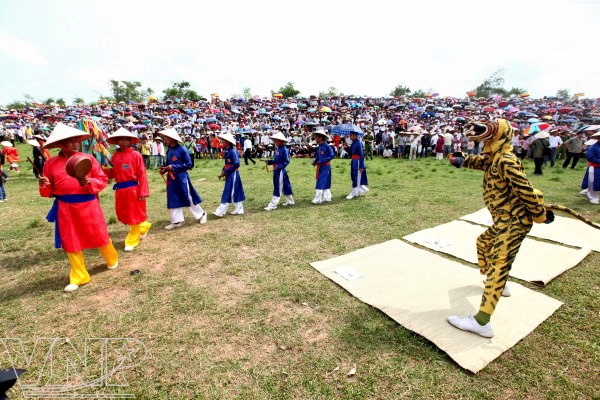
![]() The bowl-kicking performance shows the strength of “leveling the mountains and hills” of Saint Giong. ![]() Reenacting a ceremony before the troops go into battle. ![]() Tens of thousands of people watch the villagers’ performance of hunting a tiger to show the strength of Saint Giong’s troops. ![]() The “Drum-signaling man” portraying symbolizing a general of Saint Giong. ![]() A wooden horse takes the place of the iron horse ridden by Saint Giong. ![]() The image of Saint Giong’s troops fighting bravely to defeat the invaders. ![]() The image of an enemy general surrendering with a white flag in his hand. ![]() The “Gong-signaling man”, a general, beats the gong to order the triumphal troops to retreat. ![]() Troops deliver the Saint’s gifts to festival visitors. ![]() A feast for the troops to celebrate their victory. ![]() Saint Giong Festival is considered a “dramatic folk stage” because tens of thousands of local people take part. |
On April 6, the villagers carried out the ceremony of taking water, which started the festival to clean weapons before the battle and pray for good weather and bumper crops.
At 10am on April 7, a procession of trays of vegetarian food, including rice and salted egg-plant, was held to recreate the tale of the villagers who contributed food to Saint Giong.
The main festival day was on April 9 with a performance called “Phu gia” of Saint Giong’s troops. The troops consist of 120 men about 18-36 years old. They were divided into 6 armies marching back and forth in step, showing the image of a disciplined and warlike army.
At 11am, the Ai Lao troupe performed the hunting of tiger in front of Phu Dong Temple. Before starting the game, about 20 participants performed beautiful and flexible dances to the drumbeat and sound of gongs and then carried out a worshipping ceremony. The game was over when the tiger was captured. Then, many other interesting games and tales of fighting of Saint Giong’s troops were reenacted until the afternoon. After the victory, a feast was given to the troops. During the evening, cultural activities were held such as a fireworks display, a Tuong performance and folk games to celebrate the victory. The festival lasted until April 12.
Through tales with the image of Saint Giong’s troops defeating the En invaders, the image of soldiers saying goodbye to their mother before going to battle, the image of a victorious army returning to the homeland and the image of surrendering invaders, the Saint Giong Festival helped viewers learn about legends related to Saint Thanh Giong. It is not only a religious, folk and cultural activity but also a “great drama” depicting a great moment in history, culture, religion and art. It is also a profound philosophy of the struggle for life and preserving the nation as well as showing the moral standards of humans in war or peace.
For the above reasons, the Saint Giong Festival is immortal and is worthy to be honoured. At 6pm (10:20 pm in Vietnam) on November 16, 2011 in Nairobi, Kenya, the Saint Giong festival in Phu Dong Temple and Soc Temple in Hanoi was officially recognized as a world intangible cultural heritage of humanity by UNESCO.
Source: VNP
Most read
Latest Travel News
Explore Vietnam Destinations
-
Ca Na Beach: ecotourism, cultural and cuisine tourism
in Ninh Thuan
-
Ho Dynasty Citadel- A World Cultural Heritage Site
in Thanh Hoa
-
Discovering Historical, Cultural and Tourism Value of Khanh Hoa Province
in Khanh Hoa
-
Am Chua temple -cultural and historical remains
in Khanh Hoa
-
Soc Trang’s Clay Pagoda Recognized as Cultural and Historical Relic of The Mekong River Delta
in Soc Trang
-
Phong Nha-Ke Bang National Park- A world Natural Heritage recognized by UNESCO
in Quang Binh
-
Go Thap bearing great cultural and historical value
in Dong Thap
-
Hoa Lu Ancient Capital to Restore Cultural and Historical Sites of Vietnam’s Great Value
in Ninh Binh
-
Tuyen Linh Pagoda in Recognition of Nation as Cultural and Historical Heritage
in Ben Tre
-
Vibrant colorful highland markets
-
The first Mud Day in Vietnam
-
2013 Street Carnival Festival in Hai Phong
-
The beautiful pictures of Ha Giang
-
Mong ethnic minority children create playground
-
Thắng cố - a mountain specialty
-
On the Rocky Plateau
-
It's worth paying a visit to Khau Vai love market
-
Saigon after 38 years of liberation
-
Purple flamboyant blossoming in early summer
-
Northern Mountainous Market Fair opens in Hanoi
-
Earn a living in Hanoi’s Old Quarter
Travel News
Four Vietnamese breathtaking places among Top 25 Asia...
Hanoi, Ho Chi Minh City, Hoi An and Ha Long are four of the Top 25...
Events
Vietnam food festival opens in Thailand
The month-long Vietnam food festival opened in Bangkok, Thailand on June 5.