




The legend of An Dương Vương – Mỵ Châu – Trọng Thủy:
In the second century BC, Việt Nam was a country named Âu Lạc ruled by King An Dương Vương whose name prior to coronation was Thục Phán. He had only one daughter, whose name was Mỵ Châu. The State’s capital was located at Cổ Loa where the King built a fortress and ramparts. Yet, whatever was built in the day was subsequently demolished at night by evil spirits. The King held a religious ceremony and begged Heavens for assistance. There upon, a golden tortoise came and gave guidance to the King on how to do away with the malfeasance of evil spirits. As a result, the fortress and ramparts could be completed. In biding farewell, the golden tortoise presented the King with one of its claws. The King turned the claw into the trigger of his crossbow, a single arrow of which could shoot thousands of enemy troops. The crossbow was thus called as the Magic Crossbow or Tortoise Crossbow.
By then, a rebel Chinese General, Zhao To, established in Southern China a Kingdom called Nam Việt. He tried to conquer Âu Lạc State, but his military adventures ended in failure because of the magic Crossbow. Resorting to a different strategy, Zhao To sought peace and requested Thục Phán to give consent to marriage between Trọng Thủy, Zhao To’s son, and Mỵ Châu, Thục Phán’s daughter. Thục Phán gave his agreement that Trọng Thủy could, as son-in-law, stay in Âu Lạc Kingdom in keeping with the practice of uxorilocality with bride service.

The beheaded statue of Princess Mỵ Châu in Cổ Loa Temple
Taking advantage of his wife’s deep feeling of love and credulity, Trọng Thủy stole the secrets of the magic crossbow. Thereafter, he sought permission from Thục Phán to return home for visiting his parents. In departing, Trọng Thủy said to his wife, “In case war breaks out between our countries some time in the future, how can I find you?” His thoughtless wife replied, “I’ve got a coat made of goose feathers. I’ll take them out and scatter them wherever I go.”
Thereafter, Zhao To launched a new war of aggression against Âu Lạc. Being overconfident in his magic crossbow, Thục Phán did not make adequate defense preparation. When enemy troops surrounded the Cổ Loa Fortress, Thục Phán started his crossbow but found it useless. He had barely time to put his daughter on horseback and ride away at full gallop to the south. When he came near the sea coast, the golden tortoise appeared. The King asked “Oh, Golden Tortoise, why have I lost my Kingdom?” Immediately the Tortoise replied, “Your enemy is just behind you.” As the truth suddenly dawned on him, the King drew his sword and killed his daughter, and then followed the golden tortoise into the sea. The sea waves brought the corpse of Mỵ Châu to Cổ Loa, and when the villages brought it ashore it became a big stone which is still kept and worshipped in a small temple near an old banyan tree. Trọng Thủy also suffered from the loss of his wife. One day, he came to a well in front of the former palace of King An Dương Vương. As he saw the face of Mỵ Châu on the surface of the water of the well, he plunged into the well and died. The blood which poured from Mỵ Châu’s body into the sea - as the result of the cut from her father’s sword - was swallowed by oysters and shelves which subsequently produced peals. Popular imagination even went so far to assert that if the peals were washed in the water of the well where Trọng Thủy died, they would become much brighter.

Cổ Loa Festival
Every year, the 12 villages of Cổ Loa Commune join hands in organizing the festival, which usually begin on the 6th of the first lunar month.
Early on the morning of the first day of the first lunar month, 12 notables from each village come to the house of the chief notable in order to prepare for the procession which starts soon thereafter. Opening the procession is the music band, to be followed by the chief notable and the 12 village notables, and then the villagers who carry various offerings to King An Dương Vương.
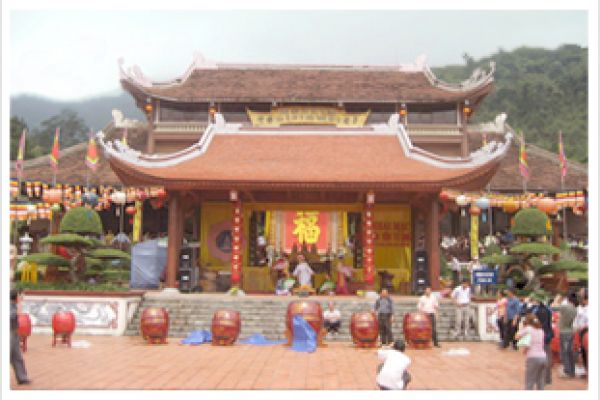
A couple of stone horses, one red and one white with embroidered saddles, stand on both sides of the outside part of the gate of King An Dương Vương’s temple. The road leading from the gate to the temple is lined with wooden stands for flags and other objects of worship. The palanquins of the 12 villages are placed in accordance with a pre-arranged order.
For the occasion, the organizers put in front of the temple a big altar with a glass box containing two gold car rings and objects of worship. A smaller alter, containing the King’s arms – sword, crossbow and bronze arrows – is set in front of the bigger alter. Beyond it is a space where a number of red – rimmed mats are spread and where the notables and the population will carry out the religious ceremony.
When the procession reaches the temple, a miniature royal court, containing an incense burner, a stone tablet, and the funeral oration, are put in front of the two altars.
The chief notable offiates at the religious ceremony in honor of the God King, which is in terms of rites quite similar to other traditional ceremonies, amidst the sound of music from the band. The nobles are followed by inhabitants. All beg the King to bestow peace and prosperity to the villages.
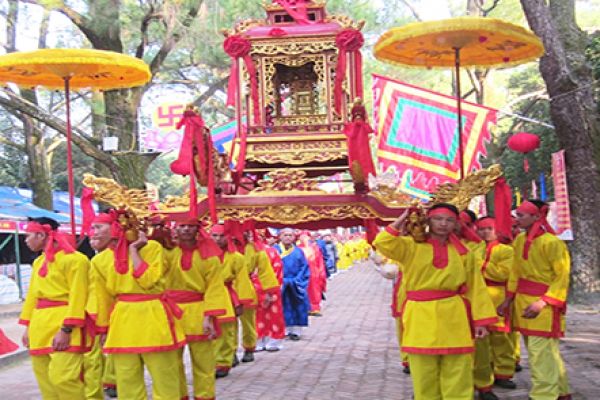
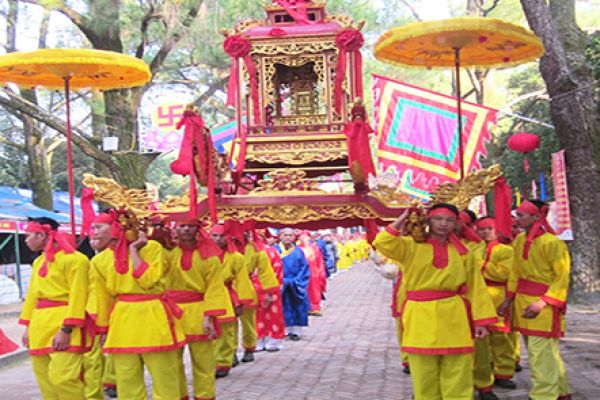
The ceremony lasts until 1 or 2 PM, and is followed by a general procession, with the participation of all the 12 villages, in honor of the King.

Art performance at the Cổ Loa Festival
In front ranks of the procession are the flags, the Miniature Royal Court and the sacred weapons of the Temple. Then come the music band and the village notables clad in traditional Court uniforms and holding the weapons supposedly wielded by the King – sword, crossbow, and arrows.
Then come the notables and inhabitants of the pagoda hamlet and of each of the 12 villages, with their own palanquins, flags and music bands. It is quite a long procession, which proceeds at a slow space, amidst the sound of music, and stops regularly to burn a round of firecrackers. Starting from the temple of King An Dương Vương, the procession comes to the Trọng Thủy Well, and then to the village gate. There upon, more firecrackers are burned and the contingent which carries the Miniature Royal Court and the royal tablets go back to the temple while the notables and population of the twelve villages would carry on the procession to their respective hamlets.
The religious ceremony and the procession end on the same day, that is, the 6th of the first lunar month, while the festival goes on until the 15th of the same month, with various traditional games and activities:
- in the night, there are fireworks, Ca Trù songs, folk theatrical plays (chèo) and conventional theatrical play (tuồng).
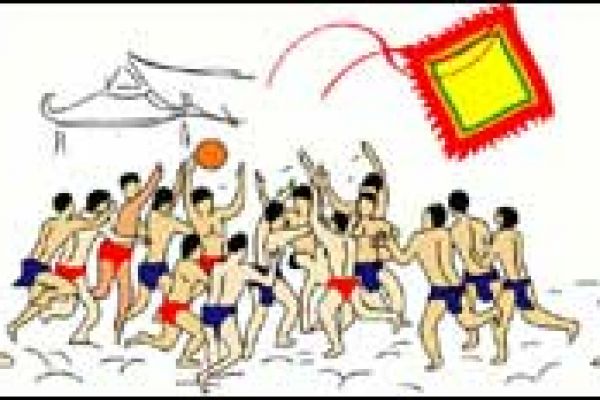
- in the day, old men play chess and cards, old women perform rites and present offerings at the Pagoda, while young men and women, a children have their own games: wrestling, tugs-of-war, swing, rope climbing, martial arts, shooting from bows and crossbows, flags dancing, human chess (chess games in which human beings are used in place of traditional chess-men), cock-fighting, penny-pitching, rice-cooking contest etc. One ancient game, which consisted in continuous drum-bearing either by pairs of drums or a whole group of drums, is no longer played.
People from neighboring communes used to come in their numbers to Cổ Loa to participate in the festival, regarding it as a national festival and spring merry-making.
Thing to do in Halong Bay Vietnam, Halong Cruise, Halong cruises, Travel to Vietnam, Vietnam Tourism, Halong bay Vietnam, Vietnam festivals


 Tags:
Tags: